“Independence and Freedom Are Most Precious”
The Sympathizer“Independence and Freedom Are Most Precious” is a revolutionary maxim that changes meaning as it moves from public inscription to personal examination and finally to political paradox. For The unnamed narrator, its apparent simplicity conceals a demand: to distinguish the freedom promised by a revolution from the freedom its rulers withhold. Repeated by Man, the phrase becomes less a correct answer than a means of exposing what that promise has come to mean.
Inscription and Political Authority
The maxim first appears as part of the furnishing of Man’s austere quarters. The room has bamboo walls, floors, furniture, and rafters; a gold-painted bust of Ho Chi Minh stands on an altar beneath a red banner bearing the words NOTHING IS MORE PRECIOUS THAN INDEPENDENCE AND FREEDOM. The arrangement gives the slogan the visual authority of an official creed. Its placement above the bust makes political doctrine part of the room’s architecture, not merely an idea spoken in conversation.
The surroundings also complicate that authority. A long table is piled with books and papers, while a guitar and record player recall objects The unnamed narrator associates with The General’s villa. At the far end, Man emerges from behind mosquito netting, his body terribly burned and disfigured. The setting joins revolutionary symbols to intimate recognition: the official maxim hangs over a meeting between former friends, one of whom has been physically marked by violence. In this room, the slogan belongs at once to the state’s public language and to the private history of those who have served the revolution.
The Question and the Failed Answer
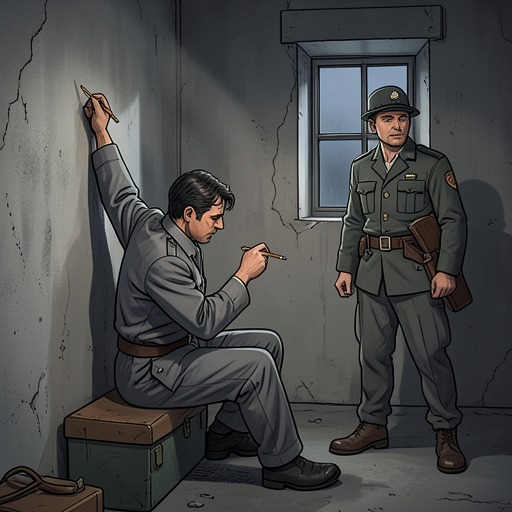
During The unnamed narrator’s reeducation, a voice offers him a final examination. It recalls how, as students, he and Man both studied intensely, but The unnamed narrator consistently knew how to produce the right answer while Man struggled to retrieve what he had learned. Now the roles seem reversed: Man says that the answer is already in The unnamed narrator’s mind and asks, “What is more precious than independence and freedom?” The question sounds like a test with an obvious solution, and The unnamed narrator expects to succeed.
Instead, he experiences the answer as close but inaccessible, as though his mind were wrapped in something soft and clammy. He eventually replies, “Nothing is more precious than independence and freedom.” The response repeats the banner’s wording, but Man tells him that it is almost right, not quite. The distinction is not a correction of the slogan’s familiar wording. It reveals that The unnamed narrator has treated the examination as a matter of recall, while Man is asking him to confront the contradiction contained in the words themselves.
The question returns in a later confrontation, where The unnamed narrator tries other possible answers, including happiness and love, before admitting that he does not know. Under pressure, he finally says, “I wish I was dead!” This answer marks a shift from reciting a political principle to naming his own despair. The maxim’s examination has made the gap between the grand promise of freedom and the suffering of a person living under coercion impossible to evade.
From Revolutionary Maxim to Paradox
Man eventually explains the distinction through a reversal: “while nothing is more precious than independence and freedom, nothing is also more precious than independence and freedom!” The repeated words are nearly identical, but their force has changed. The first is the inspiring slogan associated with Ho Chi Minh, who is dead; Man describes it as an empty suit no longer worn by its absent figure. The second turns that suit inside out. Its exposed seams make the same political language appear as a joke, revealing how a declaration of freedom can persist after its substance has been hollowed out.
For The unnamed narrator, this inversion provides an answer that rote repetition could not. A revolution that once stood for political change has become a rearguard defending its hold on power. The maxim remains recognizable, yet its repetition cannot guarantee that the people who invoke it are actually free. The phrase’s force therefore comes from the tension between its unchanged words and the changed political reality they conceal.
Historical and Narrative Significance
The unnamed narrator extends Man’s paradox beyond the revolution he has experienced. The French and the Americans, he reflects, also began as revolutionaries and became imperialists, colonizing and occupying his country in the name of saving it. The revolution in Vietnam took longer and was bloodier, but its leaders learned the habits of their former rulers and deprived defeated compatriots of the independence and freedom they had claimed to secure. The maxim becomes a measure by which both foreign power and revolutionary rule can be judged, rather than a guarantee that either deserves allegiance.
The slogan also clarifies the divided perspective through which The unnamed narrator understands himself. Man can grasp the joke because, as The unnamed narrator sees it, a man of two minds can recognize what a man with no face sees in the mirror. Their mutual recognition does not erase the violence or confinement that have separated them. Instead, the doubled maxim gives their relationship a language for seeing how a liberating ideal can turn inside out while retaining its familiar appearance. What began as a banner above Ho Chi Minh’s bust ends as a test of whether its words still name freedom—or expose its absence.